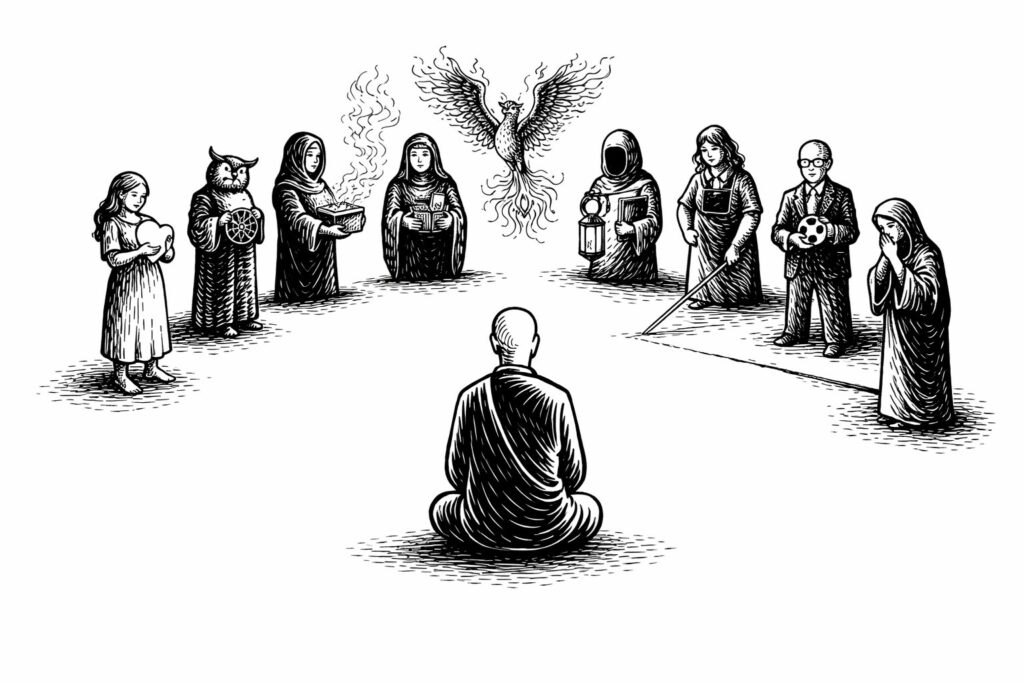
Spiral Psychology makes use of psychic archetypes, but with care.
This page explains what archetypes are, how they relate to inner parts, and—just as importantly—what they are not. The point here is to make archetypal language clarifying rather than destabilizing, and practically useful without requiring belief.
Specific archetypes are described in their own subsections under this page.
What Archetypes Are
Archetypes are recurring symbolic patterns that appear across human experience.
They describe familiar shapes of motivation, protection, longing, restraint, or exploration that emerge again and again in:
- myth and story
- dreams and imagination
- cultural narratives
- inner experience
The concept is most closely associated with Carl Jung, who described archetypes as form without content: patterns that take on specific expression through individual lives and histories.
Spiral Psychology draws on this idea without extending it into metaphysical claims.
Whether archetypes are understood as psychological structures, cultural inheritances, or something else entirely is left intentionally open. What matters here is their descriptive and practical value.
What Archetypes Are Not
In Spiral Psychology, archetypes are not treated as:
- identities to inhabit
- inner beings that take control
- indicators of destiny or spiritual rank
- truths that override lived experience
Archetypal language is used as a lens, not a label.
If a symbolic frame reduces choice, increases rigidity, or encourages identification (“this is who I really am”), it is considered misapplied.
The Spiral favors usefulness over belief.
Parts and Archetypes: A Clear Distinction
A key principle of Spiral Psychology is the distinction between parts and archetypes.
Parts are:
- personal and biographical
- shaped by lived experience
- adaptive responses to specific conditions
- embedded in the nervous system
A part develops because something happened.
Archetypes are:
- patterned and cross-personal
- symbolic rather than literal
- recognizable across many lives and stories
- impersonal in structure
An archetype describes how something commonly happens.
This distinction matters.
How They Relate
In Spiral Psychology, a part may resonate with or borrow the shape of an archetypal pattern—without being that archetype.
A simple way to think about this is:
Parts are personal adaptations.
Archetypes are shared patterns those adaptations may echo.
For example:
- a protective part may resemble a Guardian pattern
- a silencing part may align with a Sentinel or Watcher pattern
- a retrieving or exploratory part may resonate with a Seeker or Dream-oriented pattern
The archetype provides orientation, not authority.
Healing does not occur by becoming the archetype, but by helping the part that adopted its shape relax its role.
Why Archetypal Language Can Help
When used carefully, archetypal language can:
- give shape to experiences that feel hard to name
- reduce shame by showing patterns are widely shared
- create symbolic distance that supports reflection
- help parts feel seen without being exposed
In this way, archetypes can act as transitional language—bridging raw experience and reflective understanding.
They are especially useful when:
- experience feels too diffuse for literal description
- direct narrative feels overwhelming
- meaning is present but not yet articulate
When Archetypal Language Becomes a Problem
Archetypal framing becomes unhelpful when it:
- replaces attention to the body or nervous system
- overrides personal history
- encourages identification or inflation
- is used to bypass pain or responsibility
Spiral Psychology treats these outcomes as signals to return to parts work, pacing, and regulation.
Archetypes should serve integration, not substitute for it.
Archetypes and Trauma Awareness
Trauma-informed care remains the governing frame.
Because archetypal material can be emotionally potent:
- it is introduced only after foundations of safety and capacity
- it is held lightly
- it is always secondary to nervous-system state
If symbolic exploration increases dysregulation or detachment from daily life, the Spiral stance is to pause, ground, and return to simpler language.
How Spiral Psychology Uses Archetypes
Within Spiral Psychology, archetypes are used to:
- recognize recurring inner dynamics
- contextualize parts without personalizing them
- support meaning-making that remains embodied
- clarify integration rather than intensify experience
They are never used to:
- rank people
- define identity
- or replace lived accountability
A Final Orientation
Archetypes are not answers.
They are maps of recurrence.
They help us recognize what is happening without telling us who to be.
In Spiral Psychology, an archetype is considered useful only if it:
- increases flexibility
- supports regulation
- restores proportion
- and helps meaning return to life as lived
Anything else is decoration.
Next: Working With Archetypes