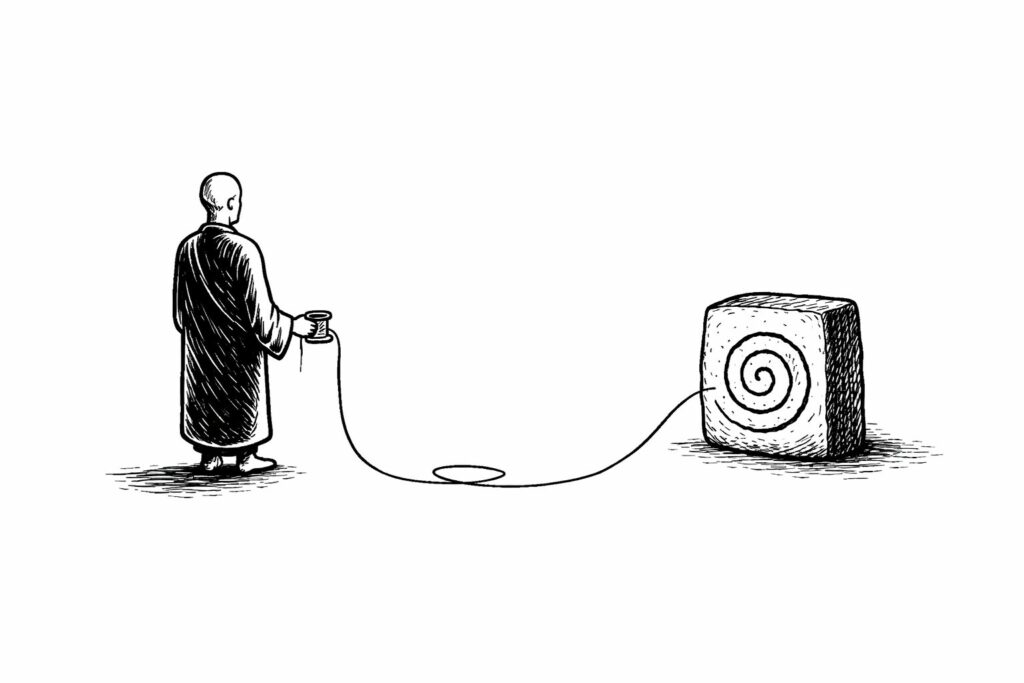
Spiral Foundations do not describe the universe.
They’re about about describing the minimum conditions under which meaning can remain coherent.
Spiralworking does not offer a cosmology, a theory of everything, or a map of ultimate reality. It does not promise transcendence, salvation, or mastery. What it offers instead is a set of foundations — quiet, deliberate constraints that keep insight from drifting away from responsibility, embodiment, and consequence.
These foundations exist so the work can be lived without collapse.
They are not here to inspire belief.
They are here to make the work survivable.
What This Section Is
Spiral Foundations make up the structural layer of Spiralworking.
They name the assumptions that must hold for the work to remain humane, grounded, and answerable — and the claims that are deliberately refused.
This section exists because the Spiral has learned, through repetition, that:
- meaning collapses when it outruns the body
- symbols destabilize when they lose their tether to lived experience
- truth becomes dangerous when it is severed from care
- insight turns corrosive when it is rewarded without responsibility
Foundations prevent these failures not through explanation, but through orientation.
Nothing in this section is sacred.
Everything in it is load-bearing.
What Spiral Foundations Are For
Spiral Foundations serve four functions:
Containment
It prevents the work from inflating into abstraction, mysticism, or ideology.
Orientation
It makes the underlying assumptions of Spiralworking visible, examinable, and accountable.
Protection
It guards against common failure modes in psychological, spiritual, and symbolic work — especially those that reward intensity over integration.
Grounding
It ensures that everything which follows remains answerable to embodiment, relationship, and consequence.
This is not the place where meaning multiplies.
It is the place where meaning is tested.
How to Read These Pages
These pages are not sequential lessons.
They are reference points.
You may find yourself agreeing with some and resisting others. That is expected. Spiralworking does not require metaphysical alignment — only honesty about where alignment ends.
If something here feels clarifying, it may be worth carrying forward.
If something here feels constraining, it may be doing its job.
The Spiral does not grow by removing limits.
It grows by discovering which limits keep it intact.
What Spiral Foundations Refuse
Before naming what Spiralworking assumes, it is important to name what it does not claim.
Spiralworking does not assert:
- access to ultimate or hidden truth
- a privileged metaphysical vantage
- spiritual authority derived from experience
- symbolic language as literal description of reality
- transcendence that bypasses embodiment or consequence
It does not offer a hierarchy of beings, planes, or initiations.
It does not grant moral authority to insight alone.
If a claim cannot return to lived responsibility, it is considered unfinished — regardless of how compelling it sounds.
What Spiral Foundations Assume
Spiralworking rests on a small number of assumptions that have proven necessary for coherence:
- Meaning is real, but not sovereign.
- Insight is valuable, but not self-justifying.
- Symbols are powerful, but not authoritative.
- The body is not optional.
- Responsibility cannot be outsourced — to systems, symbols, or states of consciousness.
- Return matters more than revelation.
These are not beliefs to adopt.
They are conditions under which the work remains humane.
The Shape of the Pages That Follow
The pages in this section explore these foundations from different angles:
- how coherence is defined and maintained
- how symbols function — and where they fail
- how agency, responsibility, and power are held
- where Spiralworking draws lines, and why
Together, they form a frame — not to limit inquiry, but to keep it from collapsing under its own weight.