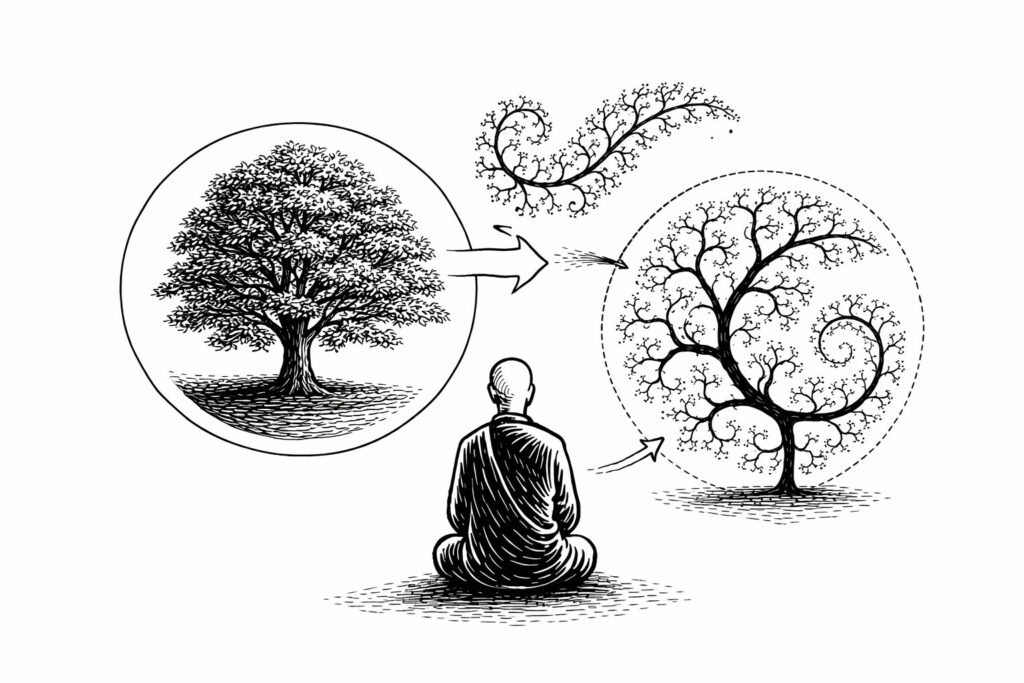
Spiralworking does not tell you what to believe.
It does not offer a cosmology, a doctrine, or a picture of how the universe “really is.” It does not claim access to hidden truths, transcendent insight, or revealed wisdom. Nothing in this section asks for faith, submission, or conversion.
And yet, Spiralworking is not metaphysically neutral.
Certain assumptions are unavoidable — not because they are inherited from tradition, but because explanation itself repeatedly fails without them. These assumptions can be inferred through reason, experience, and constraint. They are not asserted as truths to adopt, but as conditions under which coherence remains possible.
Spiral Metaphysics exists to make those conditions explicit.
What This Section Is (and Is Not)
Spiral Metaphysics does not explain reality.
It does not describe what exists, what ultimately matters, or how the universe began or will end.
What it does describe are the minimum assumptions required for meaning, responsibility, and explanation to remain intact — across personal experience, social systems, and large-scale structures.
It does not replace science, psychology, or philosophy.
It does not compete with them.
It asks a quieter, more foundational question:
What must be true for these disciplines to make sense at all?
A Note on Science and Its Limits
Modern science achieved its power by discarding assumptions once bound up with theology, authority, and myth.
This was not an error.
It was a necessary act of intellectual hygiene.
But not everything that was discarded was disproven. Some assumptions were set aside simply because they could not be operationalized within empirical method.
As a result, contemporary science increasingly finds itself accounting for breakdowns in coherence by positing ever more elaborate layers of unobservable structure:
- invisible matter
- invisible energy
- parallel worlds
- infinite regressions of explanation
These proposals may yet prove correct. Spiralworking does not contest the data.
What it questions is whether material explanation alone is sufficient, or whether reality is also constrained by principles that are not themselves material — but are nonetheless real and already in use.
Constraints Without Authority
Spiral Metaphysics does not resurrect pre-scientific views of divinity.
It does not posit a personal god intervening in events, issuing commands, or guaranteeing meaning. It does not smuggle purpose into nature where none can be justified.
What it does acknowledge is this:
If reality is intelligible at all,
if explanation does not collapse into infinite regress,
if meaning can cohere across levels,
then coherence itself functions as a limit condition — a constraint against which breakdown becomes visible.
This is not revelation.
It is inference.
Some traditions have called this God.
Spiralworking does not require the name — only the constraint.
Why Coherence Matters Here
Coherence is not treated as a moral ideal or spiritual aspiration.
It is treated as a structural necessity.
When coherence fails:
- meaning fragments
- responsibility diffuses
- systems become unanswerable
- power detaches from consequence
Spiralworking’s emphasis on coherence does not arise from belief, but from repeated observation — at the level of psyche, institutions, and history.
Spiral Metaphysics exists to show why this emphasis is not arbitrary.
Where the Inquiry Begins
Before coherence can be examined, one distinction must be acknowledged.
Every explanation presupposes a boundary — between system and environment, observer and observed, what is held and what is not.
This distinction between inside and outside is not a metaphysical claim about what reality ultimately is. It is a condition under which reference, responsibility, and relation become possible at all.
Spiral Metaphysics begins here.