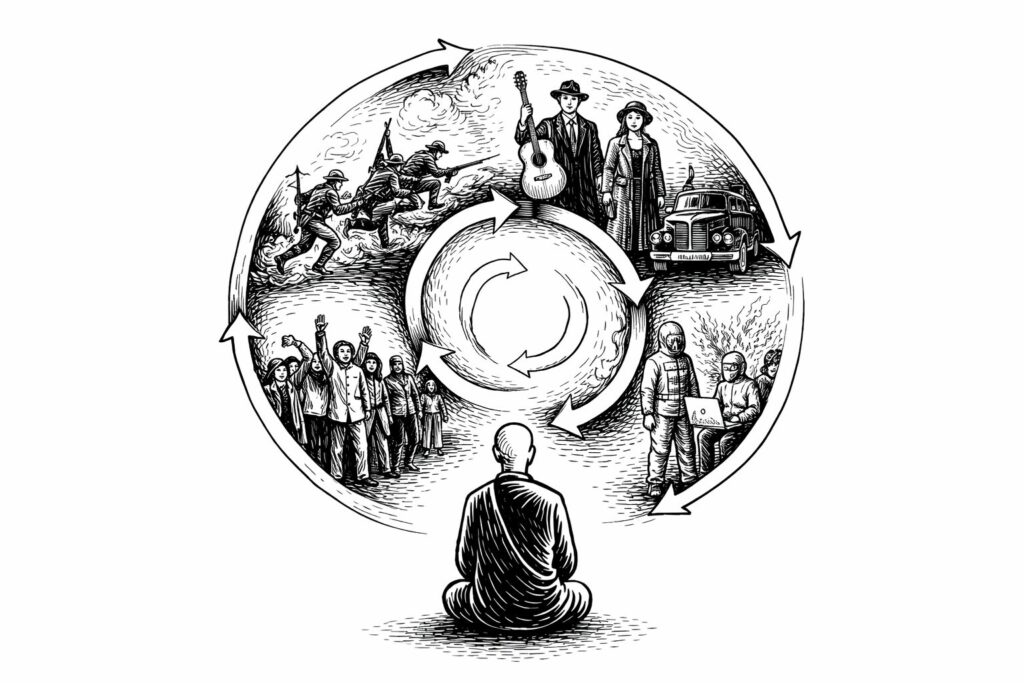
Spiralworking understands change as cyclical.
This is not a metaphor. It is an observation that appears wherever attention is sustained long enough: in individual development, in relationships, in institutions, and in civilizations. What is unresolved returns. What is overextended collapses. What loses contact with lived reality eventually breaks — and, sometimes, reforms.
Spiral History exists to notice these patterns at collective scale, not to forecast events or assign inevitability. It asks how coherence is lost and regained over time — and what that costs.
History as a Spiral, Not a Line
Linear models of history struggle to account for recurrence.
They can describe growth and accumulation, but they falter when faced with collapse, regression, repetition, and renewal. Civilizations do not simply advance. They revisit earlier tensions under new conditions, often with greater intensity and consequence.
So yes, history advances, but it does so in cycles. Just like a spiral.
Spiralworking recognizes this cyclical movement as familiar and diagnoses it as: insight without integration, systems without embodiment, meaning without return. At scale, these failures leave traces we call history.
Spiral History treats history as a record of where coherence failed — and where it was restored.
Cycles and Collective Coherence
Cyclical models of time appear independently across cultures and disciplines: in ecology, economics, psychology, mythology, and historical theory. Spiralworking does not claim ownership of these models. It recognizes their congruence.
Cycles are not scripts.
They are constraints.
They describe how systems behave when stretched beyond their limits — and how they reorganize when those limits are reached. Spiral History is interested in these limits, because they reveal the conditions under which coherence can no longer be maintained.
A Working Model: Generational Cycles
One of the most robust modern expressions of cyclical history is Strauss–Howe generational theory.
This model observes recurring generational patterns across roughly 80–100 year cycles, particularly in Western liberal societies. It tracks shifts in values, institutions, and social mood across four repeating phases, often called Turnings.
Spiralworking treats this model as a lens, not a destiny.
It is valued for its empirical grounding and descriptive power — and it’s elegant in its seasonal approach to history, with its four seasons of history, just like the year has its seasons. Where the model works, it works remarkably well. Where it does not, Spiralworking asks why.
Crises and Highs as States of Coherence
Spiral History expands on the generational model by reframing its most consequential phases.
In Spiralworking terms:
- Crises are not merely upheaval or conflict. They are periods of runaway abstraction — when systems, institutions, and narratives lose contact with lived reality. Meaning becomes procedural. Power becomes symbolic. The body is sidelined.
- Highs are not complacent golden ages. They are periods of re-embodiment — when institutions regain legitimacy by serving lived needs, when abstraction is constrained by presence, care, and proportion.
This framing shifts the focus from events to states of coherence. It asks not only what happened, but how far meaning had drifted from life.
An interesting sidenote here is that this addendum to Strauss-Howe generational theory might help to explain why the cycles that it describes are so particular to the part of the world that’s generally referred to as The West – because that’s where culture tends to reify the logical mind and the abstractions that it produces, leading to abstraction periodically outpacing embodiment in a way that requires a hard reset.
Scope and Limits
Spiral History does not claim universality.
The patterns explored here are most visible in societies with:
- dense abstraction
- formal institutions
- written law and bureaucracy
- financialized systems
- high symbolic throughput
Where abstraction can run far, its failure becomes legible as collapse. This may explain why certain cyclical models apply most clearly to Western contexts — not as a flaw, but as a diagnostic feature.
What This Section Explores
The pages that follow examine Spiral History in greater detail:
- generational cycles and archetypal roles
- Crisis as loss of coherence through abstraction
- Highs as return to embodiment and legitimacy
- elemental language as symbolic shorthand for abstraction and grounding
- how different generations tend to encounter Spiralworking
These explorations are contextual, not prescriptive. They are offered to deepen understanding, not to dictate action.
Next: Generational Cycles and Archetypes