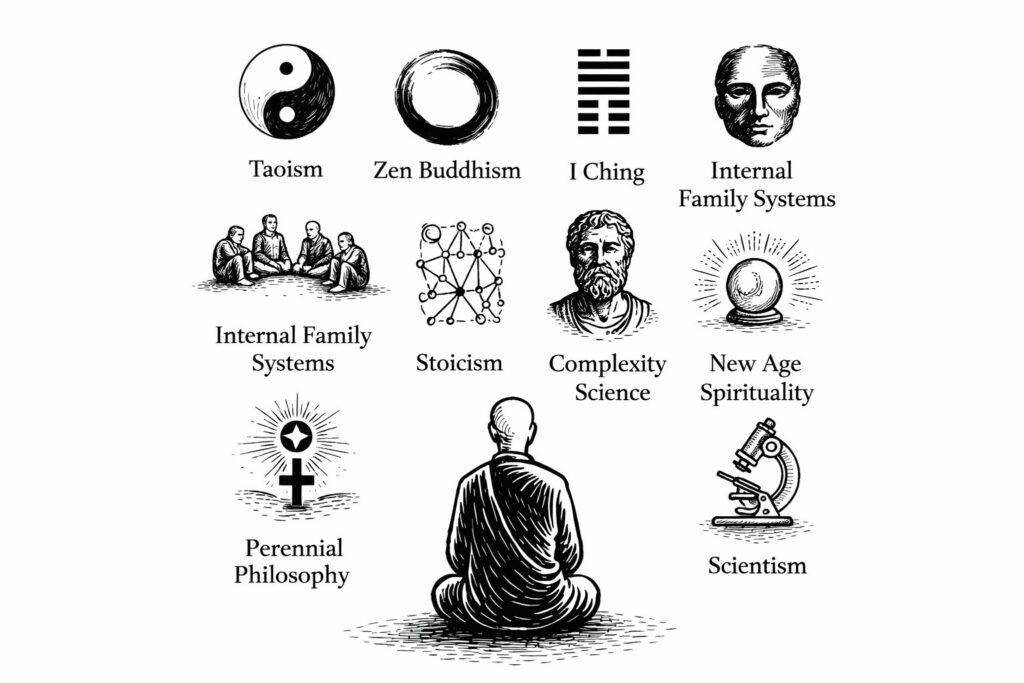
Spiralworking does not arise in isolation.
It belongs to a loose family of disciplines that, across time and context, have grappled with the same problem: how meaning, responsibility, and coherence survive complexity.
This section does not claim lineage, inheritance, or authority.
It names resonance — places where similar constraints were noticed, named, or practiced, often for different reasons and in different languages.
Resonance is not agreement.
It is shared structural concern.
High Resonance
These disciplines align closely with Spiralworking’s core assumptions: return over transcendence, coherence over domination, and practice over belief.
Taoism
Resonance: Very High (9.5 / 10)
Taoism shares Spiralworking’s suspicion of force, abstraction, and overcontrol. Its emphasis on wu wei (right effort), return, and natural correction closely mirrors Spiralworking’s understanding of coherence.
Where Taoism speaks of alignment with the Tao, Spiralworking speaks of coherence holding. The language differs; the constraint is the same.
Zen Buddhism
Resonance: Very High (9.5 / 10)
Zen’s refusal of metaphysical inflation, emphasis on direct experience, and distrust of symbolic accumulation align strongly with Spiralworking’s discipline of return.
Zen koans and Spiralworking practices function similarly: they interrupt abstraction not to replace it with belief, but to restore contact with what is already present.
I Ching
Resonance: Very High (9 / 10)
The I Ching is not treated here as prophecy, but as a symbolic grammar for situational coherence. Its focus on timing, balance, and appropriate response resonates deeply with Spiralworking’s attention to context and return.
Used well, it functions as a mirror — not an authority.
Internal Family Systems
Resonance: Very High (9 / 10)
IFS shares Spiralworking’s insistence that fragmentation is adaptive, not pathological, and that healing comes through integration rather than eradication.
The emphasis on unburdening, witnessing, and restoring internal coherence parallels Spiralworking’s psychological foundations closely.
Strong Resonance
These frameworks align strongly but diverge in emphasis, scope, or metaphysical posture.
Jungian Psychology
Resonance: High (8.5 / 10)
Jung’s work on archetypes, individuation, and symbolic life laid important groundwork for understanding meaning beyond rationalism.
Spiralworking shares Jung’s respect for symbol, but diverges in its stricter insistence on return, embodiment, and accountability, where Jungian work can sometimes linger in interpretation.
Stoicism
Resonance: High (8 / 10)
Stoicism’s focus on responsibility, proportion, and discernment under constraint resonates strongly with Spiralworking’s ethical posture.
Where Stoicism can tilt toward suppression or idealized self-mastery, Spiralworking emphasizes integration and return — but the shared concern for coherent action is clear.
Complexity Science
Resonance: High (7.5 / 10)
Complexity science’s insights into emergence, nonlinearity, and adaptive systems strongly support Spiralworking’s rejection of simplistic causality and linear progress.
Spiralworking adds an explicit concern for meaning, responsibility, and coherence, which complexity theory often brackets.
Partial Resonance
These traditions intersect with Spiralworking meaningfully, but differ in foundational assumptions or ultimate aims.
Existentialism
Resonance: Moderate (6.5 / 10)
Existentialism shares Spiralworking’s seriousness about responsibility and meaning without guarantees.
However, its frequent framing of meaning as something created against an indifferent or absurd universe diverges from Spiralworking’s emphasis on coherence as a real constraint, not merely a human projection.
Perennial Philosophy
Resonance: Moderate (6 / 10)
The perennial impulse to identify shared truths across traditions overlaps with Spiralworking’s recognition of recurring patterns.
Spiralworking diverges by refusing to treat similarity as proof of metaphysical unity or timeless truth. Resonance is structural, not revelatory.
Low Resonance
These approaches are mentioned not as opposites, but as useful contrasts.
New Age Spirituality
Resonance: Low (4.5 / 10)
New Age frameworks often emphasize transcendence, manifestation, and personal empowerment without sufficient grounding in responsibility or consequence.
Spiralworking is defined largely by what it refuses here: bypass, inflation, and belief without return.
Scientism
Resonance: Low (3 / 10)
Scientism treats scientific method not as a tool, but as the sole arbiter of meaning.
Spiralworking respects science deeply, but rejects the collapse of metaphysical, ethical, and experiential questions into measurement alone.
How to Read This Section
This list is not exhaustive.
It is not a curriculum.
It exists to help readers locate themselves — and Spiralworking — within a wider field of human attempts to stay coherent under complexity.
You do not need to agree with these disciplines.
You do not need to study them.
If one feels familiar, that familiarity may explain why Spiralworking resonates.
If none do, Spiralworking still stands on its own terms.